When the League sees an election coming up, our first instinct is almost always to set up a voter registration table. I understand why. For generations, registration was the main barrier, and the table was how we helped. I've spent more hours behind those tables than I can count. Honestly, I rarely enjoyed it. It felt like doing my duty, and it was often discouraging, especially on long afternoons when hardly anyone stopped by.
When our chapter put together a fact sheet on voter participation in our five counties, I had to rethink that instinct. In four of our counties, nearly everyone old enough to vote is already registered. And our region does vote. In every election we tracked from 2022 to 2026, we outvoted the state of Texas.
That finally explained all those quiet afternoons. So few people stopped by my table because almost everyone walking past was already registered. It wasn't that people didn't care. We were offering help most of them didn't need.
Still, in the last midterm, only about half of our registered neighbors actually cast a ballot. The other half had done the paperwork but stayed home. A registration table was never going to reach them.
With a general election coming, I think we need to ask a different question. Not "Who isn't registered?" but "Why do registered voters still stay home?"
It's easy to blame apathy, busyness, or not caring. But I don't think those answers tell the whole story. Many people who skip one election voted in the last one, so they're not indifferent to democracy. Something about this election just didn't reach them. Maybe they didn't know much about the candidates, felt unsure about the ballot, or worried about making a mistake. Maybe it just didn't feel important. Our own data shows that when people personally know who's running, turnout goes up. People show up for elections that feel like theirs.
That's what I keep thinking about. Presidential years feel like a big event, with signs everywhere, conversations at the coffee shop, and a sense that everyone is paying attention. Other elections can feel like a chore. Maybe part of our job is to make every election feel like an event again, and even fun.
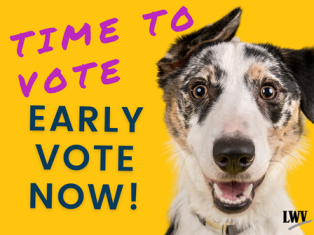 We've already seen what fun can do. In our early days, the chapter put out an early voting yard sign that many newer members have never seen. It shows a wide-eyed, grinning dog on a bright yellow background, with "Time to Vote! Early Vote Now!" in big, cheerful letters. You couldn't drive past it without smiling. It didn't lecture anyone. It just said, in the friendliest way, that an election was happening and people here vote. At some point, we stopped putting it out. I think it's time to bring that dog back.
The dog wasn't the only thing we tried. In counties where our elections administrators could join us, we've held sessions where people can try the voting equipment without any pressure. We also publish a thorough, fair voters guide for every election. It appears in all 13 newspapers serving our five counties, so it reaches a lot of homes, and people use and appreciate it. I'm proud of it. But a guide informs people, and it can't do everything. It doesn't create a sense of occasion, and it doesn't feel like a personal invitation. For the neighbor who isn't sure this election matters, or who just doesn't feel like it's their thing, information alone may not be enough. So what else could we do?
I spent five minutes by myself imagining the possibilities. Here's what I came up with: bring back the dog sign and make that dog our mascot for the season, introducing a race or two each day on Facebook. Add a QR code to the sign that links to the voters guide. Put "What's on your ballot?" table tents in local cafés. Host a ballot trivia night. Make one-minute phone videos with members in front of the courthouse. Offer pocket-sized paper cheat sheets people can fill in at home and bring when they vote. Provide Spanish-language versions of everything.
That's just my five minutes, one person's ideas. It's only the tip of the iceberg.
Imagine what nearly a hundred of us could come up with, across five counties that know how to throw a good party. We live in a place of dance halls, church picnics, festivals, and fish fries. We know how to gather. Why shouldn't an election be one more reason to celebrate together?
Here's what I most want us to remember: the fun shouldn't only be for voters. It should be for us, too. A lot of civic work can feel like duty. We sit at a folding table, hand out flyers, and hope someone stops by. But joy is contagious, and so is weariness. If we're having a great time, people notice and want to join in. If we're just grimly doing our duty, people notice that too.
So what would make this season joyful for you? What would you actually look forward to? Maybe it's putting out dog signs across the county together on a Saturday morning, baking for a coffee morning, writing silly ballot trivia questions over supper, or filming a video with your grandkids. Maybe it's something none of us has thought of yet.
Whatever we try has to stay balanced and nonpartisan. Fun doesn't mean taking sides. We should also keep asking whether we're reaching people who wouldn't have voted otherwise, not just our most faithful friends. But those are guardrails, not reasons to stay behind the folding table.
The simplest idea might still be the best: the personal invitation. A friend saying "I found this helpful, thought you might too," or even "Want to go vote together and grab lunch afterward?" does more than any flyer.
The registration table still matters. There are neighbors, especially in DeWitt County, who aren't registered yet, and we should keep finding them. But it can't be all we do. The bigger opportunity is the half of our registered neighbors who are just waiting for a reason to show up.
So here's my invitation to you. Send me your wildest, silliest, most wonderful ideas. Let's brainstorm together and pick a few to try this fall. Let's see what happens when we stop treating elections as homework and start treating them as something worth celebrating. Democracy is something we get to do together, and it's allowed to be joyful.